
4/11/2026
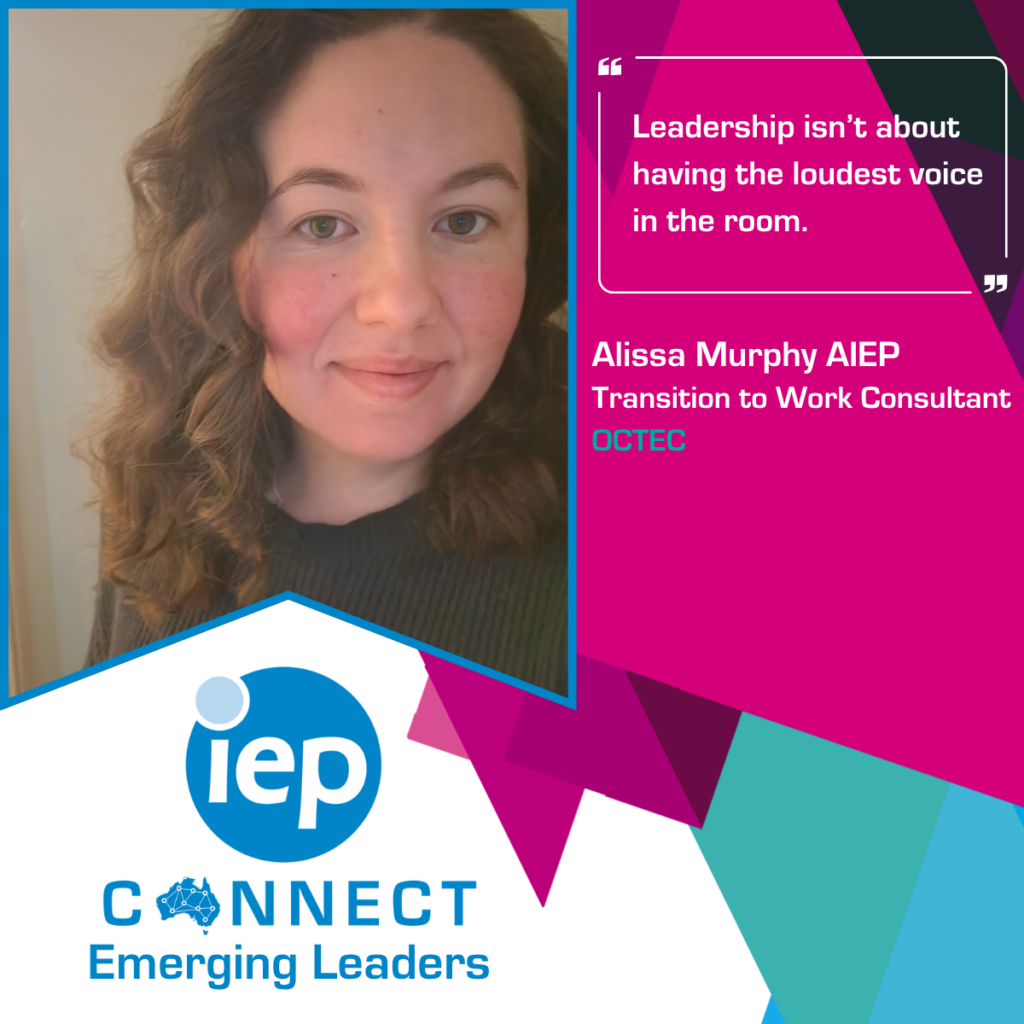
Alissa Murphy AIEP, Transition to Work Consultant at OCTEC, on emerging leadership, trust and learning as you go.
Leadership is one of the most rewarding, and challenging, transitions in the employability profession. We sat down with Alissa Murphy AIEP, Transition to Work Consultant at OCTEC, to discuss what leadership means to her, drawing on her experience in senior retail management and the community and youth employment sector.
What does being an emerging leader mean to you?
For me, being an emerging leader is about recognising that you’re never really finished learning. It’s about being open to new ideas, challenging your own thinking and being comfortable with the fact that you won’t always have all the answers.
I think it’s also about recognising that leadership isn’t necessarily about being the person in charge. It’s about the impact you have on others, the support you offer and the opportunities you create for people to grow.
Has your idea of leadership changed throughout your career?
Definitely. Having worked in senior retail management and now in the community and youth employment sector, I’ve had the opportunity to experience leadership in quite different environments.
Earlier in my career, I probably viewed leadership more through the lens of managing operations, achieving targets and supporting team performance. While those things are still important, I’ve come to realise just how much of leadership comes down to people.
Understanding what motivates someone, what they’re struggling with, what they’re good at and what helps them feel valued can make such a difference. Sometimes taking the time to understand someone can have a much bigger impact than simply telling them what needs to be done.
I now find my conversations are more about seeking to understand, so I can support in a way that is valued and meaningful. Sometimes it’s finding moments where perhaps it’s just a closed mindset that needs help seeing a different perspective to unlock potential.
Can you be a leader without having a leadership title?
Absolutely! I think some of the best examples of leadership happen without a title attached to them.
It’s in the way we support our colleagues, the initiative we take, the relationships we build and the way we encourage others. You don’t need a management title to influence someone positively, challenge a way of thinking or help someone see what they’re capable of.
What experiences have shaped the type of leader you want to become?
Working with young people has probably had one of the biggest influences on the type of leader I want to become.
Supporting young people from all different backgrounds and circumstances has really reinforced the importance of empathy and taking the time to understand someone’s story rather than making assumptions about their situation.
I’ve also had opportunities throughout my career to step into leadership responsibilities, including providing regional leadership support where I had quite a personal challenge going from college to senior and then leader very quickly and having to manage relationships whilst being the leader who delivered and implemented big changes within my organisation. These experiences have helped me understand the importance of building trust, being approachable and creating an environment where people feel comfortable asking questions, sharing ideas and having a go.
I’ve learned that leadership isn’t about having the loudest voice in the room. Sometimes it’s about being the person who listens, asks the right questions and gives others the confidence to contribute.
Why is giving people autonomy and confidence important to you?
I think people do their best work when they feel trusted and supported.
As leaders, it’s easy to want to jump in and provide the answers, particularly when we have experience or know how something should be done. But I think we sometimes take away valuable learning opportunities by doing that.
People need the opportunity to make decisions, try things differently, get things wrong and learn along the way. I want the people I work with to feel confident enough to take ownership of their work, share their ideas and trust their own abilities, knowing they have support behind them if they need it.
I feel if the team have trust and understanding within their leader, they naturally support the team and leader as a collective.
What have you learned about yourself through developing as a leader?
I’ve learned that developing as a leader requires you to be just as willing to look at yourself as you are to understand others.
I’m learning that everyone works differently, communicates differently and is motivated by different things. What works for one person might not work for another, and being able to recognise that is really important.
I’ve also learned that I don’t need to have all the answers. Being able to say I don’t know, ask questions or seek guidance isn’t a weakness. If anything, I think it creates a much better environment for learning and growth.
What do you think good leaders do when they get things wrong?
I think they own it. Good leaders need to be able to acknowledge when they’ve got something wrong, have the conversations that might not always be comfortable and be willing to learn from the experience.
I don’t think being a leader means being perfect or always knowing what to do. We’re human too, and I think it’s important to remember that. If we expect our teams to be open to feedback, learning and growth, we need to be willing to demonstrate those same things ourselves.
What kind of leader would you like to be known as in the future?
I’d like to be known as someone who genuinely invests in people.
Someone who leads with honesty and empathy, builds trust, challenges perspectives and encourages people to see possibilities beyond what they might initially believe is achievable.
I want people to feel supported but also challenged, trusted to make decisions and confident enough to step outside their comfort zone.
I’d also love to be the kind of leader who leaves people feeling more confident in themselves and their abilities than they were before working alongside me.
Ultimately, I think one of the greatest measures of leadership is the positive impact you have on the people around you, not just what you achieve yourself.
I’m still learning and figuring things out along the way, and I think that’s what makes being part of an Emerging Leaders program so valuable. Having the opportunity to learn from, be challenged by and gain different perspectives from other leaders is something I genuinely appreciate.
About IEP Connect Online: Emerging Leaders
IEP Connect Online: Emerging Leaders is a free peer network that extends the spirit of IEP Connect beyond networking events, creating an ongoing space where new and aspiring leaders can connect, exchange ideas and learn from experienced leaders who understand the realities of leading frontline employability teams.
- Monthly online discussions
- 45–60 minute peer-led sessions
- Open to IEP Members, Partners and Fellows
- Attend one session or the full series
To learn more, contact australia@iemployability.org