

2/03/2026
Frontline practitioners across Australia know that some participants face a mix of barriers that don’t fit neatly into one box. People may be dealing with trauma, mental health concerns, housing instability, disability, family violence or substance use — often at the same time. When these pressures stack up, engagement can feel challenging, and even the most experienced practitioners can find themselves asking, ‘Where do I start, and what will genuinely help this person move forward?’
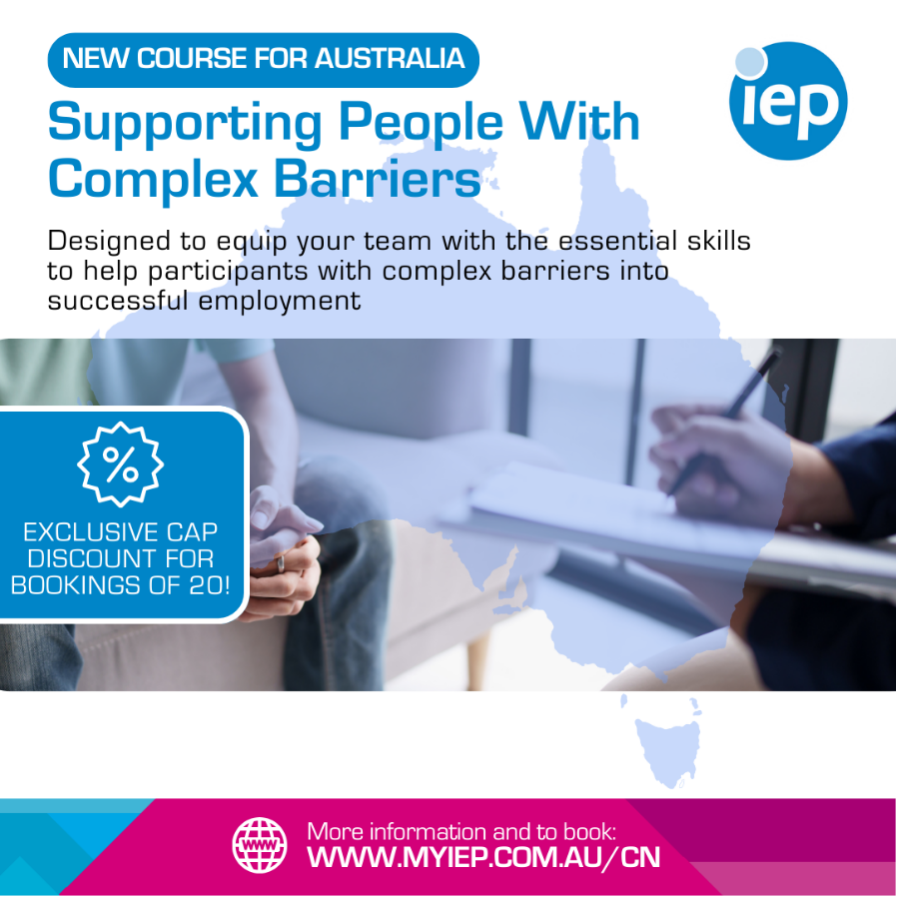
IEP Australia’s Supporting People with Complex Barriers program was built for this space. The course focuses on the real‑world situations practitioners see every day and offers practical tools, grounded approaches and realistic strategies that support safe, respectful and effective engagement.
Rather than theory for theory’s sake, the program strengthens the core capabilities that matter in frontline work:
- Understanding what sits beneath complex barriers
- Building trust and safety
- Using practical, trauma-aware approaches
- Working in a way that reduces pressure
- Recognising when to step in, step back or seek support
It’s a course designed to build confidence, clarity and capability — supporting practitioners to do the important work they already do, with greater ease and impact.
Bridging Compassion and Capability
The program is built on a simple idea: while compassion is essential, practitioners also need grounded, real‑world tools they can rely on when things feel challenging or uncertain. Designed to fit the rhythm of frontline work, the course is delivered over four live, two‑hour sessions. Each session offers immediately usable strategies — informed by evidence and shaped by the lived experience of people who have worked directly in employment services, youth programs, disability support, mental health and community services.
The facilitators aren’t just trainers; they’re practitioners who understand what complex work looks and feels like. They bring real examples, practical scenarios and an understanding of the emotional load that comes with supporting people facing multiple barriers.
What Participants Will Walk Away With
This program gives practitioners the skills, clarity and confidence to respond to complexity with steadiness rather than stress. Participants learn how to:
- Notice signs of complexity early, even when a person isn’t talking about their challenges directly
- Build trust with people who may have had hard or traumatic experiences with services
- Communicate in a calm, supportive way when someone feels overwhelmed or shut down
- Support small, realistic steps forward without losing direction or momentum
- Maintain healthy professional boundaries while staying warm, respectful and connected
Just as importantly, the program focuses on the human side of this work. Practitioners build strategies to:
- Protect their own wellbeing
- Stay grounded during challenging conversations
- Keep their confidence, compassion and judgment clear — even on days when the work feels heavy
By the end of the program, participants feel more equipped to navigate complex situations with clarity rather than uncertainty, and steadiness rather than stress.
Designed for the Australian Context
This program has been developed specifically for Australian services and the realities practitioners work in every day. It can be tailored to suit different settings — Employment Services, the NDIS, Youth and Community programs, Housing and Crisis support, and regional or culturally diverse communities.
Who It’s For
The program is ideal for anyone working with people experiencing multiple, intersecting barriers, including:
- Employment Consultants and Job coaches
- Case Managers and Support Workers
- NDIS and Disability Practitioners
- Youth and Community Workers
- Mental Health and Wellbeing teams
- Housing, Family Violence and Crisis Support Workers
- Team Leaders, Supervisors and Frontline Managers
If you or your team support people navigating the ‘hard stuff,’ this program is designed for you.
A Worthwhile Investment for Teams and Organisations
The impact goes beyond individual learning. Teams that complete the program often develop:
- A shared language for discussing complex cases
- More consistent, aligned practice across staff
- Stronger collaboration and problem‑solving
- Increased resilience and reduced burnout
- Improved outcomes and safer service delivery
For organisations, it represents a meaningful and sustainable uplift in workforce capability — strengthening both the quality of service and the wellbeing of the people delivering it.
If you’d like to learn more about Supporting People with Complex Barriers or discuss tailoring the program for your organisation, reach out to the IEP Australia team at learning-aus@iemployability.org