
1/09/2026
12 November 2026, 9:30 AM – 10:30 PM | The Promenade Docklands, Melbourne
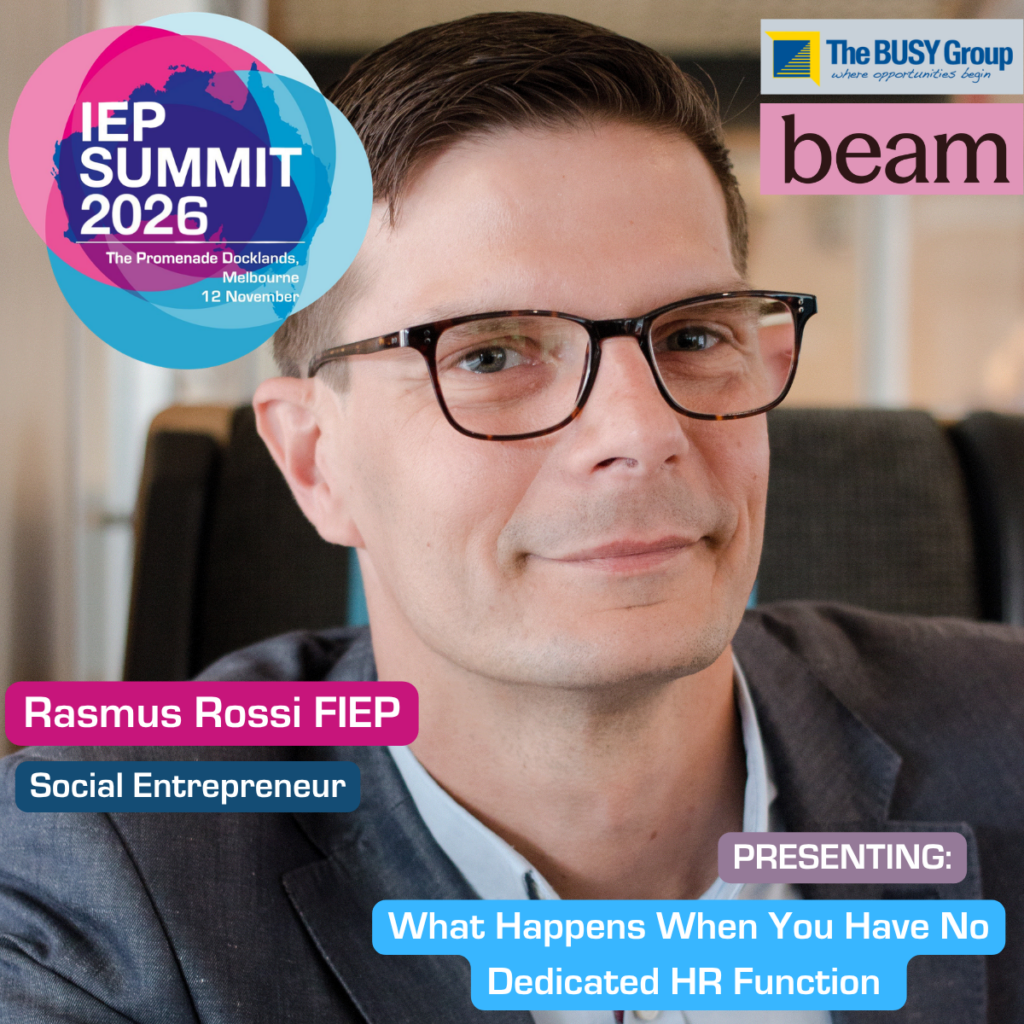
Rasmus Rossi FIEP is another brilliant addition to the speaker lineup for IEP Summit Australia 2026: Thriving Through Change – Talent, Technology, and the Future Workforce, kindly sponsored by The Busy Group and Beam.
Rasmus is a Swedish entrepreneur, business leader, and education innovator with more than 25 years of experience at the intersection of employability, adult education, workforce development, and digital transformation.
For the Summit’s third session of the day, Rasmus will be discussing What Happens When You Have No Dedicated HR Function.
Topics include AI in hiring, skills versus qualifications, inclusive recruitment practices, and the retention challenges facing the employability sectors. Expect diverse perspectives on balancing traditional HR approaches with emerging workforce trends.
Ahead of the Summit, we sat down with Rasmus to talk about the future of recruitment, what he’s looking forward to in Melbourne, and the challenges facing the employability sector.
Can you tell us about what the audience can expect from your session?
“Recruitment is undergoing a fundamental shift, and I believe this should also make us question one of the most established assumptions in modern organisations: should recruitment and skills assessment primarily be an HR responsibility?
“For decades, companies have built recruitment processes around CVs, formal qualifications, previous job titles and standardised job descriptions. At the same time, much of the responsibility for identifying and assessing talent has gradually been transferred from operational managers to HR functions and recruitment specialists. That model made sense in a relatively predictable labour market. I am less convinced that it will work in the labour market we are now entering.
“AI, automation, demographic change and rapidly evolving skills requirements mean that companies increasingly need to recruit for potential, adaptability and future capability, rather than simply matching someone’s past experience against a predefined job description. The half-life of skills is becoming shorter, roles are changing faster, and organisations cannot assume that the competencies they need tomorrow will look like the competencies they employ today.
“This changes the role of the line manager fundamentally.
“The people closest to the business need to become much better at understanding their own capability requirements, identifying skills gaps, recognising transferable skills and assessing human potential. Recruitment and skills mapping can no longer be something managers simply outsource to HR and then become involved in when presented with a shortlist of candidates. Talent decisions are business decisions, and the capability to make them needs to sit much closer to where value is actually created.
“HR will continue to have an important role, but I believe that role will increasingly shift from owning recruitment to building the systems, tools, data and capabilities that enable managers to make better talent decisions themselves.
“AI makes this transition particularly interesting. Technology can help us identify hidden skills, analyse capability gaps and reveal candidates whose potential would never have been visible through conventional CV screening. But the ultimate competitive advantage will not come from having access to AI, because eventually everyone will have access to similar technology. The advantage will come from having managers who know how to use it, who understand people, and who can recognise potential that competitors overlook.
“I believe the companies that successfully move recruitment and skills intelligence closer to their operational leadership will gain a significant competitive advantage. In a labour market where talent and skills are increasingly scarce, the ability to recognise potential earlier, develop it faster and deploy it better than your competitors may become one of the most important capabilities an organisation can possess.”
What are you most looking forward to at the 2026 Australia Summit in Melbourne?
“I’m particularly looking forward to comparing the Australian experience with what we are seeing in Sweden, the Nordic countries and Europe more broadly.
“Many of the challenges are remarkably similar: employers reporting skills shortages while significant groups remain outside the labour market, rapidly changing skills requirements, demographic change and the growing impact of AI. Yet countries have chosen very different ways of organising employment services and working with providers.
“The most valuable part of an international Summit is therefore not simply sharing success stories. It is being able to compare systems honestly, understand what has actually produced measurable results, and take those lessons back into our own markets. I’m also very interested in the professionalisation of the employability workforce and how we can strengthen the skills, methods and status of the people who work every day to help others into sustainable employment.”
What do you think are the biggest issues facing the employability sector in Australia right now?
“From an international perspective, I see one of the biggest challenges as the gap between labour market demand and the people who remain disconnected from employment. Australia is certainly not alone in this. Across Europe we see employers struggling to recruit while, at the same time, many people remain unemployed or underemployed.
“That tells us that employability is not simply an unemployment problem. It is a matching, skills and inclusion problem.
“The sector also needs to respond to AI. AI will change recruitment, skills assessment, career guidance and service delivery very quickly. Used well, it can allow practitioners to spend less time on market demand and creating sustainable employment outcomes. That is a conversation I’m very much looking forward to continuing in Melbourne.”
Save the Date
12 November 2026 | The Promenade Docklands, Melbourne
Rasmus’ session follows Bernard Salt AM, who will open the Summit with ‘The Changing Face of a Candidate’, setting the scene on Australia’s shifting workforce ahead of a panel exploring youth pressures, mature-age participation and genuine workforce inclusion. Further speakers and panel details will be announced soon.
If you work in employability services, policy or strategy, this is one day you don’t want to miss.
Get your tickets here – Members and Fellows receive a special discount.
You can pay by invoice, or in up to 3 instalments.
For more information on the Summit, visit myiep.com.au/iep-summit-2026.
Any questions about IEP Summit or IEP Membership? Message us at australia@iemployability.org
More on Rasmus Rossi FIEP
As CEO of one of Sweden’s largest employment services organisations, Rasmus led thousands of employees across hundreds of locations, supporting job seekers, employers, municipalities, and government agencies. His leadership focused on combining operational excellence with innovation to improve employment outcomes and create lasting social impact.
Throughout his career, he has worked extensively with governments, municipalities, employers, and education providers to improve the way people develop skills and move into sustainable employment. He has led large-scale organisations, managed complex public-private partnerships, and contributed to the development of innovative approaches that place people, rather than systems, at the centre of learning and career development.
Rasmus is widely recognised for challenging conventional management thinking. He believes that people leadership is the primary responsibility of every manager, not a separate HR department. In his view, the best organisations are built when leaders take full ownership of recruiting, developing, coaching, and supporting their people. HR should provide expertise and tools, but accountability for people should always remain with the leader.
Today, Rasmus is Co-Founder of ScaleApp Education, where he combines his deep understanding of workforce development with the opportunities created by artificial intelligence and modern learning technology. He is also actively involved in several international initiatives exploring employability, lifelong learning, and the future of skills across Europe.
Rasmus is a frequent speaker on AI in education, employability, leadership, and innovation. His work is driven by the belief that technology should not replace human potential, but amplify it, making learning more personal, engaging, and immediately applicable to real life and work.
Find out more about our Summit Australia 2026 lineup and agenda.